Home / Programmes / Goats & permaculture
Coming soonGoats & permaculture
Livestock and sustainable farming to help families build an income.
Starting soon
Our programmes are being prepared now. None of them is running yet. We will share real news, with real photos, as each one begins.
Why goats
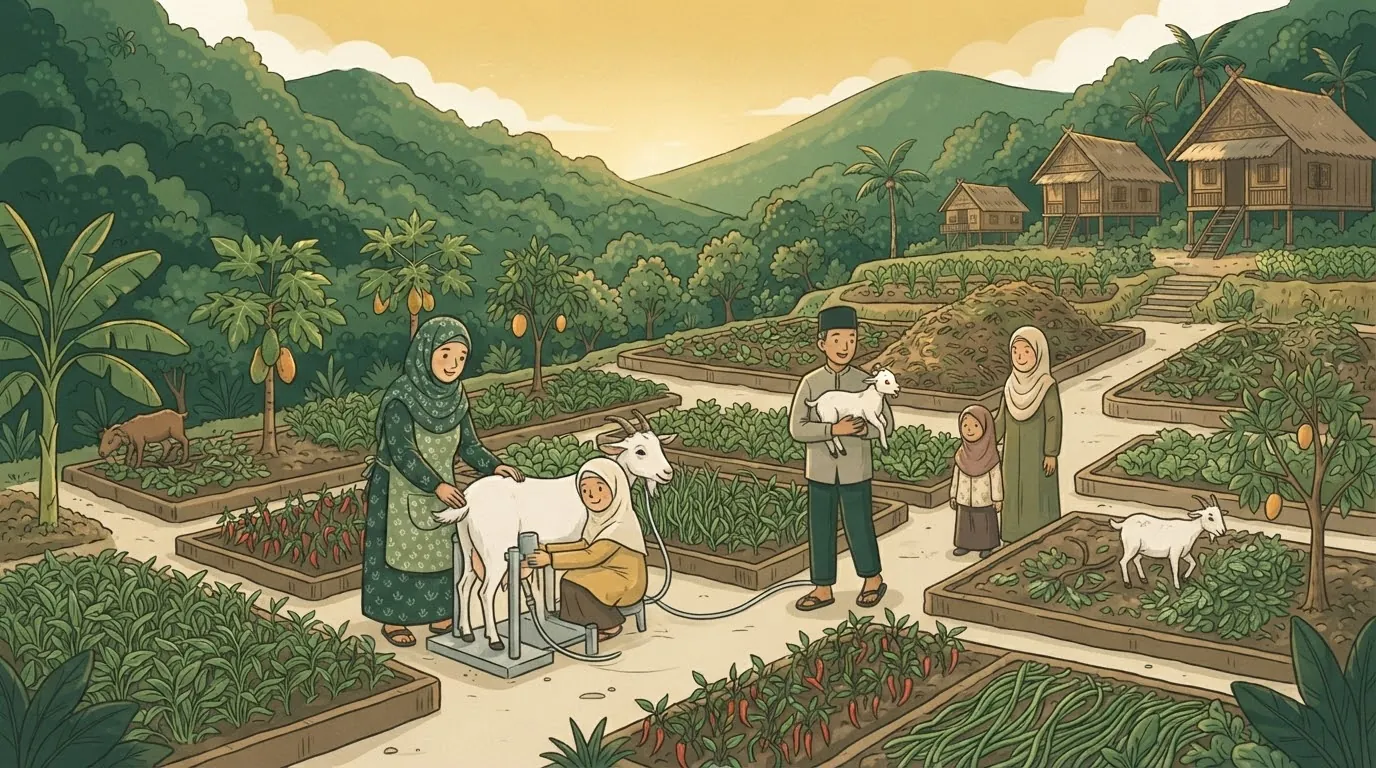
Goats suit small farms. They eat what grows locally, breed quickly and give both milk and meat. Goat milk carries about 3 to 5% protein.
Where families have been given goats, it shows: in Rwanda, households given a goat ate nearly twice as much meat, and their children's weight improved a little.
Better breeds, carefully
Indonesia already has good crosses to build on: Peranakan Etawa and Sapera for milk, and Boer crosses for meat, which grow 33 to 48% heavier than the local Kacang goat. We'll improve our herd through careful crossbreeding, with advice from Australian livestock experts and the Faculty of Veterinary Medicine at Universitas Syiah Kuala.
How families take part
Families can look after goats, share a herd or join the training. Families who receive goats pass their first female kids on to the next family, so the herd keeps growing through the village. In a large trial in Nepal, this approach raised families' goat income by 70 to 100% and returned about 2.5 times its cost.
Permaculture
Permaculture means designing a farm to work the way nature does: soil, water, plants and animals supporting each other, with little brought in from outside. Goat manure feeds the soil, crops and trees feed the goats, and nothing is wasted.
A study of 286 projects in 57 countries using farming methods from the same family found yields rose 79% on average.
Keeping Aceh clean
Atrazine and paraquat have been used on farms in Aceh. In November 2025 the World Health Organization's cancer agency classed atrazine as probably carcinogenic (Group 2A). Europe withdrew atrazine in 2004 and paraquat in 2007. Atrazine can last for months in soil and much longer in groundwater.
We want Aceh's farms free of them. Our aim is organic, to Indonesia's national standard (SNI 6729).
Power
The farm will run on power from our river turbines.
When
We're preparing it now, alongside the hydro power.
Sources
- Goat milk in Indonesia: IOP Conference Series, 2022
- Goat milk protein: Biodiversitas, 2022
- Boer crosses in Indonesia, 2023
- Livestock pass-on trial, Nepal: UC Davis
- Goats and child growth, Rwanda: Food Policy, 2014
- Faculty of Veterinary Medicine: Universitas Syiah Kuala
- What permaculture is: Agronomy for Sustainable Development, 2014
- 286 farming projects in 57 countries: FAO and Oxfam summary
- Atrazine reclassified, November 2025: IARC
- Atrazine fact sheet: NPIC
- Atrazine and paraquat used in North Aceh: Agrium, 2019
- EU decision not to renew atrazine, 2004
- Paraquat bans including the EU in 2007: review, 2025
- Indonesia's organic standard, SNI 6729:2025
 Youth academy